Why the method matters
A budget is a plan for your money. The specific format you use to build that plan shapes how easy it is to follow, how quickly you spot problems, and whether the habit sticks over time. Understanding several established methods gives you a starting point for choosing one that fits your income pattern, spending behavior, and financial goals.
If you are still building your foundational vocabulary, this personal finance glossary covers terms you will encounter across nearly every budgeting conversation.
The methods below are widely documented and practiced. None of them guarantee results; each carries trade-offs. This article is general financial information, not personalized advice. For guidance tailored to your own circumstances, consult a licensed financial professional.
Zero-based budgeting
Zero-based budgeting starts with your expected income for a given period and assigns every dollar to a specific category until the balance reaches zero. That zero does not mean you spend everything; it means every dollar has a named purpose, including savings and debt repayment. At the end of the month, unspent dollars in one category must be intentionally moved elsewhere rather than left to drift.
This method works well for people with predictable, regular income and those who want a precise account of where money goes. The trade-off is time: building and maintaining a zero-based budget requires more active management than looser systems.
Every dollar gets a named purpose before you spend a cent of it.
The 50/30/20 framework
The 50/30/20 framework divides after-tax income into three broad categories: roughly 50 percent for needs (housing, utilities, groceries, minimum debt payments), 30 percent for wants (dining, entertainment, subscriptions), and 20 percent for savings and extra debt paydown. The percentages are guidelines, not rigid rules.
This approach requires less granular tracking than zero-based budgeting and is often recommended for people who find detailed category systems overwhelming. Its weakness is that the 50 percent needs allocation can be difficult to meet in high-cost-of-living areas, where housing alone may exceed that share of income.
Broad categories make this framework easier to maintain than line-item systems.
The envelope method
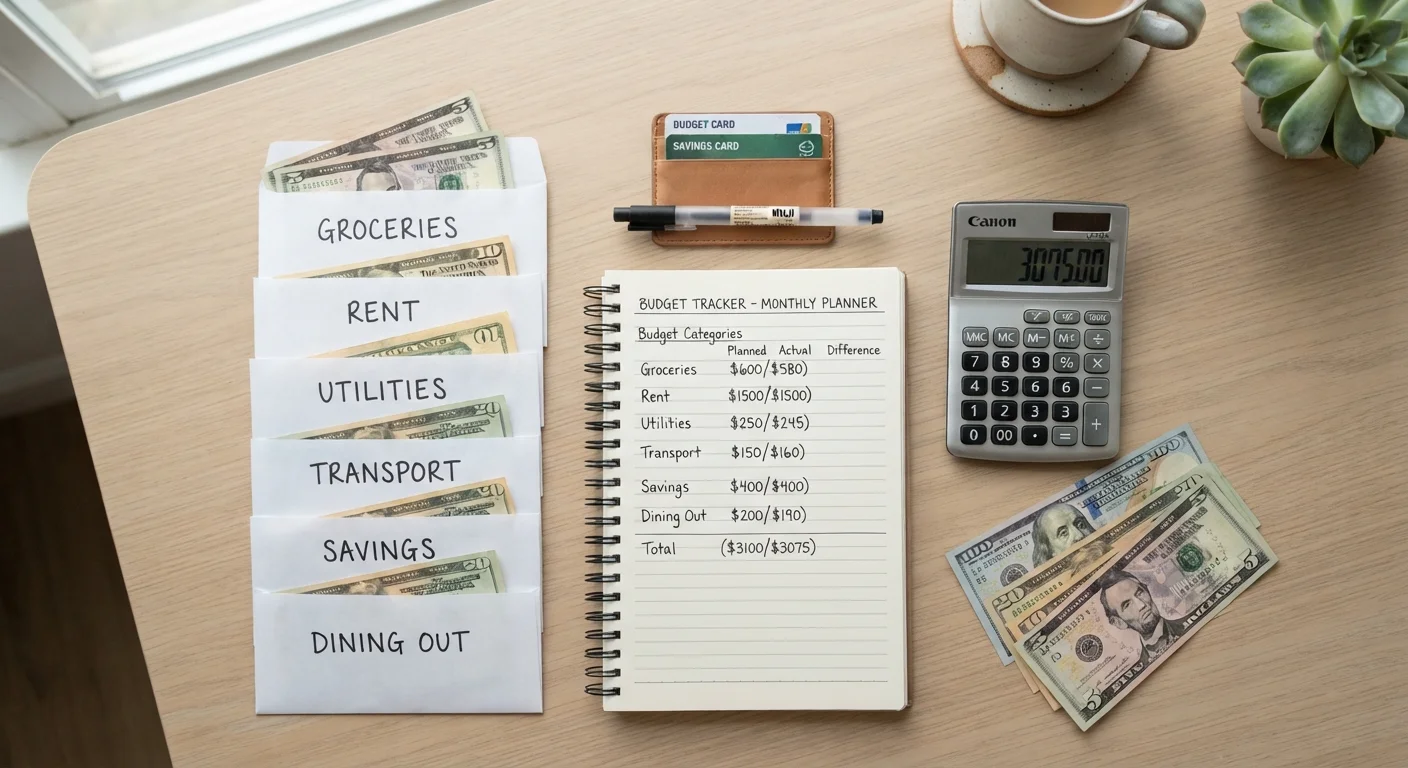
Originally a cash-based system, the envelope method involves setting a spending limit for each variable category and placing that amount of cash in a labeled envelope. When the envelope is empty, spending in that category stops for the period. Digital versions replicate the same logic using budgeting apps that cap spending by category.
The tactile version can be effective for people who overspend on variable categories such as groceries or dining because the physical constraint makes limits concrete. It is less practical for households that rely primarily on card transactions or online purchases, though digital envelope tools address that gap.
Physical cash limits can make spending restrictions more concrete than a spreadsheet column.
Pay-yourself-first budgeting
Pay-yourself-first budgeting reverses the usual sequence. Instead of saving whatever remains after spending, you move a set amount to savings or debt repayment at the start of the pay period, then live on what is left. Automated transfers make this easier to maintain consistently.
This method prioritizes long-term financial goals without requiring detailed category tracking. It works best when the amount set aside is realistic; an overly ambitious transfer that leaves too little for essential expenses often gets reversed, undermining the habit. If you are also planning for discretionary expenses like travel, the same logic applies: planning costs before you depart prevents savings from being eroded by unplanned spending.
Automating savings at the start of the period removes the decision from the end of the month.
Values-based budgeting
Values-based budgeting does not prescribe fixed percentages or category caps. Instead, it asks you to identify what you genuinely prioritize, then allocate spending to match those priorities while cutting back in areas that matter less to you personally. There is no universal template because the categories and proportions reflect individual choices.
This approach suits people who find rigid systems demotivating but still want a framework for conscious spending decisions. It requires honest self-assessment and periodic review to stay aligned. Without some structure around essential expenses and minimum savings, it can also be easy to rationalize overspending under the label of personal values.
Allocating money to match stated priorities can increase follow-through compared to arbitrary percentages.
Reverse budgeting with a spending account
A variation related to pay-yourself-first, this approach routes income into a dedicated account for fixed and essential expenses, sets automated transfers for savings and debt, and treats whatever remains in a separate account as freely spendable. The goal is to handle obligations automatically and eliminate ongoing decisions about whether a discretionary purchase is affordable.
The method reduces budgeting friction for people whose fixed costs are stable and predictable. It can obscure variable cost increases over time, though, if the fixed expense account is not reviewed regularly. It also requires a reasonably stable income; irregular pay makes the math harder to set up reliably.
Automating obligations first can reduce daily financial decision fatigue considerably.
Choosing and sustaining a method
Most people try a method for a month, abandon it, and conclude that budgeting does not work for them. The more common failure is a mismatch between method and lifestyle, not a failure of discipline. Variable income households, for example, often find percentage-based approaches less stressful than fixed-category systems, because the numbers flex with what actually came in.
Switching methods is not failure. Plenty of households blend elements from two approaches, such as using a pay-yourself-first structure for savings while applying envelope limits to discretionary spending.
Start with one month of tracking
Before committing to a method, spend one month recording every dollar spent without changing behavior. That baseline shows your actual spending pattern rather than an idealized version of it. Choosing a budgeting method based on real data makes the initial category allocations far more accurate and sustainable.
If housing, transportation, or healthcare costs are under pressure, a budgeting method helps you see the problem clearly but does not resolve it on its own. For a detailed look at one category many people underestimate, see vehicle ownership costs most drivers overlook. Retirees comparing healthcare-specific strategies may also find this overview of managing healthcare costs in retirement useful alongside any budgeting framework.
This article is for informational and educational purposes only and does not constitute personalized financial, tax, or legal advice. Consult a qualified financial adviser before making decisions based on your individual situation.